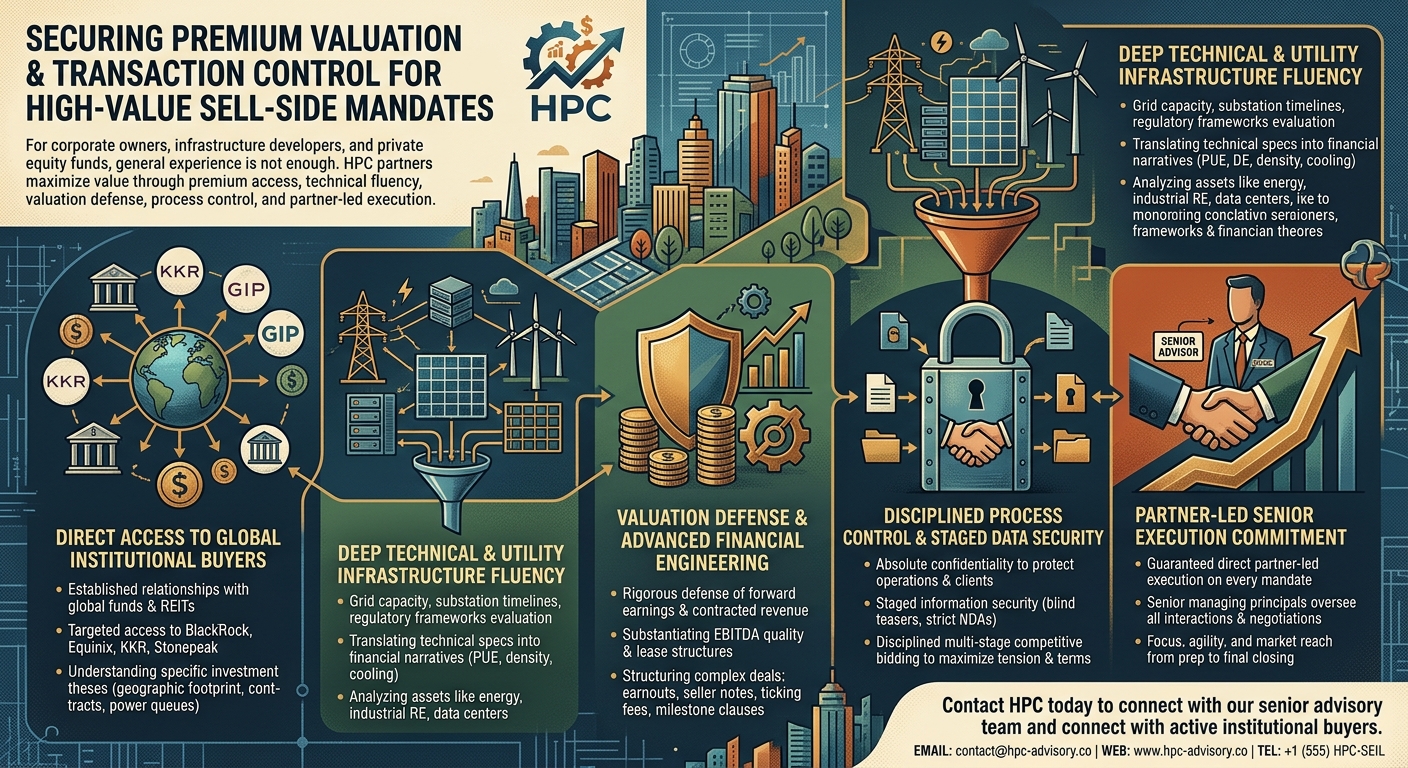
When corporate owners, infrastructure developers, and private equity funds evaluate advisory firms to handle sell-side mandates, general transaction experience is never enough. High-value sell-side execution requires a partner capable of defending asset valuations, protecting operational confidentiality, and driving competition among qualified global buyers. Through our trusted HPC partner network, asset sellers gain direct access to active institutional buyers, specialized industry expertise, and senior-led execution designed to maximize transaction value and secure optimal deal terms.
Direct Access To Global Institutional Buyers
Sellers require advisors who maintain established relationships with specific buyer classes rather than relying on broad market outreach. Our extensive HPC partner network provides direct connectivity to global infrastructure funds such as BlackRock, GIP, KKR, and Stonepeak, as well as digital infrastructure REITs like Equinix and Digital Realty, sovereign wealth vehicles, and corporate strategic acquirers. We understand the specific investment thesis of each prospective buyer, whether their focus centers on expanding geographic footprint, acquiring high-quality tenant contract backlogs, securing critical grid power queues, or scaling regional operating platforms.
Deep Technical And Utility Infrastructure Fluency
Translating complex operational assets into clear enterprise value drivers requires deep technical and utility infrastructure fluency. In energy, industrial real estate, and data centre transactions, our advisory team evaluates grid capacity, substation delivery timelines, and regulatory frameworks to highlight true asset potential. We translate technical specifications including power density, PUE efficiency, cooling topology, redundancy structures, and brownfield conversion scope into compelling financial narratives for institutional underwriters.
Valuation Defense And Advanced Financial Engineering
Maximizing exit value demands rigorous defense of forward earnings and contracted revenue streams. We specialize in substantiating EBITDA quality, evaluating long-term lease structures, and defending historical operating performance during buyer due diligence. Furthermore, our advisory framework handles complex deal mechanics seamlessly, incorporating structured earnouts, seller note rollovers, ticking fees, and milestone-based site assignment clauses to protect seller interests and optimize capital recovery.
Disciplined Process Control And Staged Data Security
Protecting ongoing business operations, vendor relationships, and client retention requires absolute confidentiality throughout the transaction lifecycle. We implement strict staged information security protocols, utilizing anonymous blind teasers, enforceable non-disclosure agreements, and controlled virtual data room access. By designing a disciplined multi-stage competitive bidding process, we generate strong competitive tension among pre-screened institutional buyers to push purchase prices higher while tightening deal terms.
Partner-Led Senior Execution Commitment
Sellers often experience frustration when large investment banks delegate critical mandates to junior analysts following contract signing. HPC guarantees direct partner-led execution on every sell-side mandate. Senior managing principals oversee buyer interactions, commercial negotiations, and transaction structuring from initial asset preparation through to final closing. Whether managing single mid-market industrial assets or multi-asset infrastructure platforms, our team delivers the focus, agility, and market reach required for successful completion.
If your enterprise or fund is evaluating sell-side advisory options and seeking active institutional buyers for high-value assets, contact HPC today to connect with our senior advisory team.
Frequently Asked Questions for Enterprises in Kuwait Seeking Sell-Side Advisory
1. How does HPC assist enterprises in Kuwait with sell-side advisory mandates?
HPC provides independent commercial advisory, business valuation defense, and direct access to global institutional buyers to help corporate owners in Kuwait achieve maximum transaction value.
2. What types of buyers can enterprises in Kuwait reach through the HPC partner network?
Corporate sellers connect with global infrastructure funds, digital infrastructure REITs, sovereign wealth vehicles, and strategic international corporate acquirers.
3. How does HPC defend the valuation of an enterprise operating in Kuwait?
Advisors substantiate EBITDA quality, defend forward earnings projections, and validate contracted revenue backlogs during rigorous buyer due diligence.
4. Can family-owned businesses in Kuwait utilize HPC for full corporate exits?
Yes, family-owned enterprises and private shareholders in Kuwait receive tailored advisory support to structure complete equity sales or majority stake divestments.
5. How is operational confidentiality maintained during a sell-side process in Kuwait?
HPC enforces strict staged information security using anonymous blind teasers, legally binding non-disclosure agreements, and controlled virtual data room access.
6. What role does HPC play in evaluating technical assets for sellers in Kuwait?
Technical advisors translate complex operational specifications, power queue allocations, and facility infrastructure into clear enterprise value drivers for institutional underwriters.
7. How does HPC generate competitive tension among prospective buyers for Kuwait assets?
Advisors design a disciplined, multi-stage auction process that forces multiple qualified international buyers into structured bidding timelines.
8. Are senior partners directly involved in managing sell-side mandates for firms in Kuwait?
HPC guarantees partner-led execution on every mandate, ensuring managing principals lead buyer negotiations and transaction structuring from inception to deal completion.
9. What specialized deal mechanics can HPC structure for enterprise sellers in Kuwait?
Advisors expertly handle complex terms including performance earnouts, seller note rollovers, ticking fees, and milestone-linked site assignment clauses.
10. How long does a typical sell-side advisory engagement take for a company in Kuwait?
Transaction timelines vary based on business complexity, but structured processes typically move from initial preparation to final closing within four to eight months.
11. What financial documentation must an enterprise in Kuwait prepare before launching a sale process?
Sellers need audited financial statements, historical tax records, customer contract backlogs, detailed operational budgets, and clear asset ownership titles.
12. How does HPC assist data centre and tech infrastructure sellers in Kuwait?
Advisors evaluate grid capacity, power density, PUE efficiency metrics, and substation delivery schedules to present maximum enterprise value to institutional REITs.
13. Can mid-market commercial businesses in Kuwait access global private equity capital through HPC?
Yes, mid-market enterprises across diverse sectors leverage HPC’s international network to attract cross-border private equity investment.
14. How does HPC handle uncollected accounts receivable during a sell-side transaction in Kuwait?
Advisors work with sellers to structure working capital pegs, invoice financing solutions, or specific balance sheet adjustments prior to final transaction pricing.
15. What sectors generate the highest buy-side demand for assets based in Kuwait?
High-demand sectors include clean energy infrastructure, manufacturing facilities, logistics hubs, data centres, and specialized B2B service firms.
16. How does HPC help sellers in Kuwait navigate cross-border regulatory compliance?
Advisory teams coordinate with international legal specialists to ensure full compliance with foreign direct investment rules and local statutory requirements in Kuwait.
17. What is the difference between a broad auction and a targeted sale process for Kuwait companies?
A targeted process discreetly approaches a curated group of pre-qualified buyers matching specific investment criteria, whereas a broad auction maximizes initial outreach.
18. Can corporate spin-offs and subsidiary divestments in Kuwait be managed by HPC?
Yes, HPC assists parent corporations in carving out operational units, evaluating shared services, and executing clean subsidiary sales.
19. How are earnout structures managed to protect sellers in Kuwait?
Advisors establish clear, objective performance metrics and governance rights to ensure sellers receive earned post-closing contingent payments.
20. What steps are involved in the initial preparation phase for a sell-side mandate in Kuwait?
Initial steps include comprehensive financial normalization, business valuation benchmarking, confidential information memorandum drafting, and virtual data room assembly.
21. How does HPC assist industrial asset owners in Kuwait with sale-and-leaseback strategies?
Advisors help industrial firms sell real estate assets to institutional investors while securing long-term lease agreements to maintain operational continuity.
22. What happens if a prospective buyer attempts to renegotiate terms during due diligence in Kuwait?
HPC leverages maintained competitive tension and defended financial metrics to reject unjustified price re-chips and uphold agreed heads of terms.
23. Can greenfield project developers in Kuwait sell equity stakes through HPC?
Yes, developers holding early-stage or shovel-ready infrastructure permits connect with global institutional investors seeking greenfield equity positions.
24. How does HPC evaluate customer concentration risk for enterprise sellers in Kuwait?
Advisors highlight recurring revenue models, long-term contract lengths, and high switching costs to mitigate buyer concerns over client concentration.
25. What role do virtual data rooms play in sell-side transactions across Kuwait?
Secure virtual data rooms allow prospective buyers to inspect audited financials, legal contracts, and operational data under strict permission controls.
26. How are non-compete agreements structured for outgoing business founders in Kuwait?
Advisors negotiate fair non-compete scopes and durations that protect buyer investments while allowing founders reasonable future professional flexibility.
27. Can distressed or restructuring businesses in Kuwait utilize HPC sell-side advisory?
Yes, HPC assists companies requiring accelerated M&A execution, balance sheet recapitalization, or strategic asset sales under tight timelines.
28. How does HPC verify the financial capability of prospective buyers targeting Kuwait assets?
Advisors screen all interested parties for proven capital availability, investment committee approvals, and successful transaction track records before granting deep data access.
29. What is a blind teaser and how does it protect businesses in Kuwait?
A blind teaser is an anonymous executive summary that outlines business strengths and key financial metrics without disclosing the company identity or location.
30. How does HPC address environmental and sustainability compliance for sellers in Kuwait?
Advisors organize environmental audits and highlight ESG-aligned operational practices to attract premium valuations from sustainability-focused global funds.
31. Can logistics and distribution companies in Kuwait attract international acquirers?
Yes, strategically located warehousing and distribution networks attract global logistics operators seeking expansion into key transit corridors.
32. How are working capital adjustments calculated at the closing of a deal in Kuwait?
Transactions establish a target working capital baseline, with final purchase price adjustments made upward or downward based on actual closing balance sheets.
33. What advisory support does HPC offer during management presentation sessions?
Advisors coach executive teams, refine presentation decks, and conduct practice sessions to ensure management effectively communicates business value to buyers.
34. How does HPC help sellers in Kuwait evaluate competing buyer offers?
35. Can energy developers in Kuwait sell operational hydropower assets through HPC?
Yes, operational hydropower facilities with stable power purchase agreements attract strong interest from yield-focused infrastructure funds.
36. What measures prevent employee leakage or panic during a sale process in Kuwait?
Strict process secrecy ensures key employees are informed only at designated strategic milestones, backed by retention bonus planning where appropriate.
37. How does HPC structure seller note rollovers for corporate exits in Kuwait?
Advisors establish secure interest rates, clear maturity schedules, and appropriate subordination terms when sellers agree to defer a portion of purchase proceeds.
38. Can software and technology firms in Kuwait secure strategic acquirers through HPC?
Yes, technology companies with proprietary intellectual property and scalable SaaS revenue models connect with global tech consolidators and growth equity funds.
39. What is the role of an exclusivity period in sell-side negotiations?
Exclusivity grants a selected buyer a limited time window to finalize due diligence and legal contracts without competition, granted only after firm terms are agreed.
40. How does HPC assist manufacturing companies in Kuwait with high capital expenditure histories?
Advisors demonstrate how past capital investments reduce future maintenance spending, supporting higher EBITDA valuation multiples.
41. What legal documentation is finalized during the closing phase of a company sale in Kuwait?
Closing involves executing a definitive Share Purchase Agreement or Asset Purchase Agreement, disclosure letters, employment contracts, and escrow arrangements.
42. How does HPC help sellers in Kuwait manage vendor due diligence reports?
Commissioning independent vendor due diligence reports upfront speeds up buyer reviews, reduces transaction friction, and prevents unexpected price adjustments.
43. Can healthcare and pharmaceutical entities in Kuwait execute sell-side mandates with HPC?
Yes, healthcare providers, laboratories, and pharmaceutical businesses receive specialized advisory targeting institutional healthcare funds and corporate groups.
44. What key metrics determine the valuation multiple for an enterprise in Kuwait?
Valuation multiples depend on historical revenue growth, EBITDA margins, market share, management team strength, IP uniqueness, and overall sector demand.
45. How are escrow accounts utilized in cross-border acquisitions involving Kuwait firms?
Escrow accounts hold a portion of purchase funds for a specified post-closing period to cover potential warranty claims or indemnity obligations.
46. Can commercial real estate portfolios in Kuwait be sold alongside operating businesses?
Yes, HPC structures transactions to either bundle operational real estate into corporate sales or separate property assets into dedicated sale-and-leaseback deals.
47. How does HPC ensure smooth post-merger integration planning for sellers in Kuwait?
Advisors help outline transition service agreements to ensure operational continuity and clear administrative handovers during ownership transfers.
48. What role do ticking fees play in long-duration transaction closings in Kuwait?
Ticking fees compensate sellers with incremental daily accruals if a buyer delays transaction closing past an agreed target date due to regulatory reviews.
49. How does HPC assist engineering and construction firms in Kuwait with sell-side strategies?
Advisors highlight long-term project pipelines, contracted order backlogs, and specialized technical workforces to secure attractive acquisition multiples.
50. How can enterprise owners in Kuwait initiate a confidential sell-side review with HPC?
Business owners and corporate decision-makers can reach out directly to the HPC advisory team to schedule an initial confidential consultation and preliminary valuation assessment.